
Key Takeaways
- A Rasayana Herb: Ashwagandha is honoured in Ayurveda as a Rasayana and a Balya (strengthening) herb, described in the Charaka Samhita, Sushruta Samhita and Ashtanga Hridaya.
- Traditional Uses: It is traditionally used to support a calm mind, restful sleep, strength, ojas, comfortable joints, vitality and healthy ageing.
- Vata and Kapha Balancing: Warming and grounding, it is best taken in warm milk at bedtime, especially in the cold months. People with a strong Pitta nature take it in moderation.
- Quality and Guidance: Choose root-based, organic, lab-tested products from a licensed maker, and consult a practitioner first if you are pregnant, have liver or thyroid concerns, or take regular medicines.
Many of my patients ask me about ashwagandha. They see it in advertisements, hear about it from relatives, and wish to know how it is truly used.
Ashwagandha is one of the most cherished herbs of Ayurveda, praised in our classical texts for centuries. In this guide, I will explain what ashwagandha is traditionally used for, how Ayurveda understands it, the forms in which it is taken, and how to choose and use it wisely.
What Is Ashwagandha, in Simple Words?
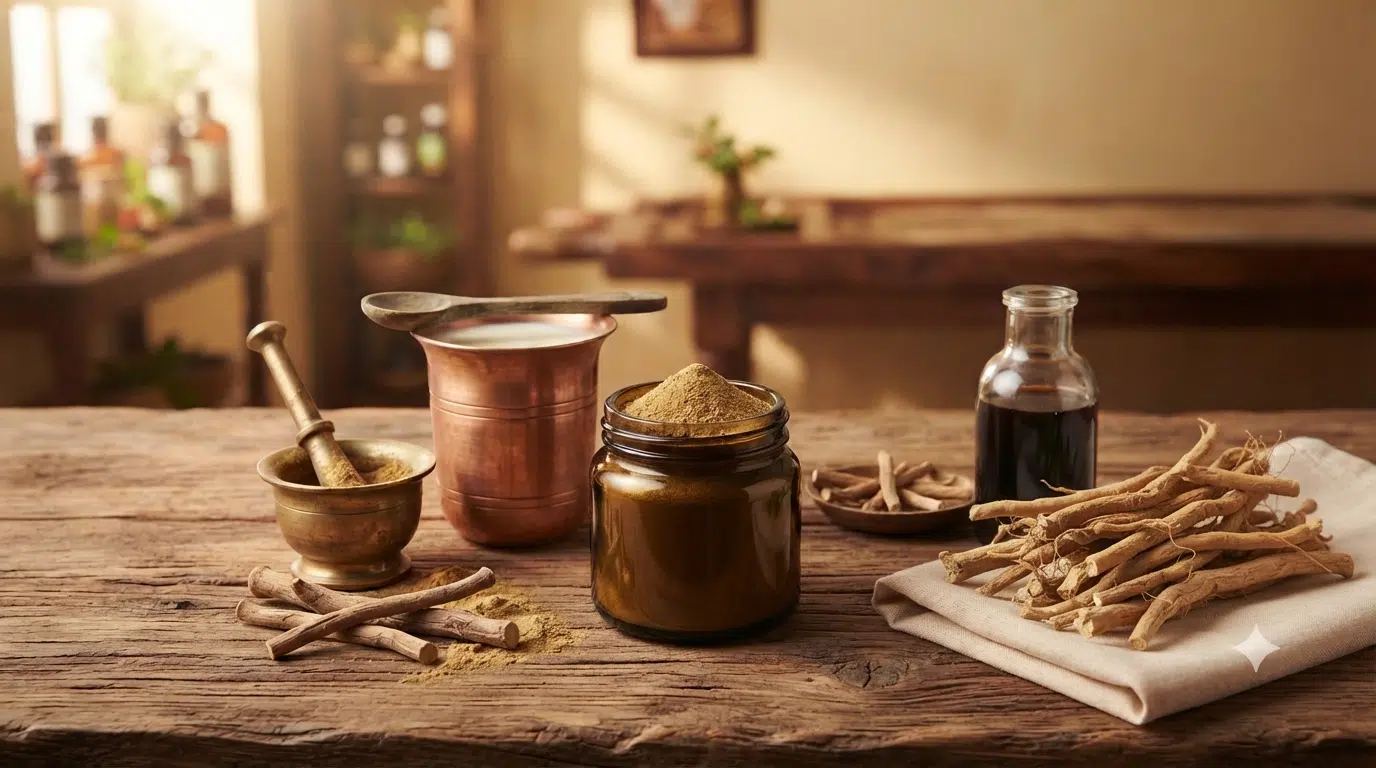
Ashwagandha is a small shrub, and its root is the part most often used. Its botanical name is Withania somnifera. It is also called “Indian ginseng” or “winter cherry.”
The name has a lovely meaning. Ashwa means horse and gandha means smell. The fresh root has a distinct earthy fragrance, and the name also points to the strength and vitality the herb is said to bestow. The classical text Bhavaprakasha lists many of its Sanskrit names, such as Vajigandha, Hayagandha, Varahakarni, Kushthagandhini and Balada, which means “giver of strength.”
In Ayurveda, ashwagandha is honoured as a Rasayana, a herb that nourishes the body and mind and supports long-term wellbeing and graceful ageing. Some texts describe it as a Sattvic Kapha Rasayana, one that builds strength while keeping the mind clear and steady.
You may also hear the word “adaptogen.” It is a newer word for something Ayurveda has long described: a herb that helps a person adapt, balancing the body as needed.
I have practised Ayurveda for more than 20 years. In that time I have read the pulse of thousands of patients, a method we call Nadi Pariksha, and I have used ashwagandha with many of them. It is a herb I return to again and again, and I always choose it to suit the person in front of me.
Ashwagandha in the Classical Texts
Ashwagandha appears across the great classical works of Ayurveda, including the Charaka Samhita, the Sushruta Samhita and the Ashtanga Hridaya, together known as the Brihatrayi.
- In the Charaka Samhita, it is placed among the Balya (strength-promoting) and Brimhaniya (nourishing) groups of herbs, and in the Madhura skandha, the group of sweet-tasting herbs. It is also an ingredient in classical preparations such as Vajikarana ghrita.
- Later texts called Nighantus continue to describe its strengthening action (Balya) and its use in restoring those who have become weak or depleted (Kshayahara).
- Texts also place it among the Medhya Rasayanas, the herbs that support memory and learning.
This long and consistent description across the centuries is one reason Ayurvedic physicians hold the herb in such high regard.
The Ayurvedic Profile of Ashwagandha
Ayurveda describes every herb through its Rasapanchaka, five qualities that tell us how it behaves in the body:
| Rasa (taste) | Bitter (tikta), pungent (katu) and astringent (kashaya) |
| Guna (quality) | Light (laghu) and unctuous (snigdha) |
| Virya (energy) | Warming (ushna) |
| Vipaka (after-digestion effect) | Sweet (madhura) in most descriptions |
| Dosha action | Balances Vata and Kapha |
Because of this profile, ashwagandha is described as Balya (strengthening), Rasayani (rejuvenating), Shukrala (supporting reproductive vitality) and Veeryaprada (bestowing vigour).
What Is Ashwagandha Used For? Traditional Benefits
Here is how Ayurveda traditionally uses this herb.
For a Calm and Steady Mind
This is the most common reason people come to me asking about ashwagandha. In Ayurveda, restlessness, worry, irritability and a scattered mind are linked to a Vata that has become unsettled. Ashwagandha is warming, grounding and nourishing, so it is traditionally used to soothe Vata and bring the mind back to steadiness.
Calming practices work beautifully alongside it, such as simple breathing practices for calming the mind. You can read more – Shirodhara for Stress : How it may calm overactive mind.
For Restful Sleep
The classical texts describe ashwagandha as Nidrajanana, a herb that supports sleep. It is traditionally taken in the evening, often in warm milk, to settle a restless mind at bedtime. For more on rest, you can read – Ayurvedic Insomnia Treatment : 8 Great Therapies and Benefits.
For Strength, Stamina and Recovery
Ashwagandha is a classic Balya and Brimhaniya herb. Ayurvedic physicians have long used it to support muscle strength, stamina and the rebuilding of the body after illness, exertion or long periods of tiredness.
For Ojas and Natural Resilience
In Ayurveda, immunity is understood through ojas, the refined essence of the body’s seven tissues (dhatus). Ojas is the reserve of vitality that gives us glow, patience and resilience. Ashwagandha is considered one of the best Rasayanas for building healthy ojas, which is why it is a favourite in the winter months, and is one of the herbs found in the well-known Chyawanprash.
For Comfortable Joints
Ayurveda links stiff, achy joints to aggravated Vata, a condition called Sandhivata. Ashwagandha, taken internally with milk and used externally in medicated oils, is traditionally used to support comfortable joint movement.
For Vitality and Reproductive Wellbeing
The Vajikarana branch of Ayurveda deals with vitality and reproductive health. Ashwagandha is among its foremost herbs and is traditionally used to support healthy libido, stamina and reproductive wellbeing.
For Healthy Ageing
As a Rasayana, ashwagandha is part of the Ayurvedic approach to Vayasthapana (supporting the years of life with strength and clarity). It is traditionally included in long-term routines for healthy ageing.
How Does Ayurveda Explain Ashwagandha?
Ayurveda speaks of three body energies called doshas. One of them is Vata, the energy of movement. When Vata is balanced, we feel light, creative and calm. When it rises too much, a person may feel restless, worried, dry in the skin, stiff in the joints or light in their sleep.
Think of Vata like the wind. When the wind is gentle, the day feels calm. When it is too strong, everything feels unsettled. Ashwagandha is like a heavy, warm blanket on a windy night: grounding, nourishing and steadying.
Ashwagandha is like a heavy, warm blanket on a windy night: grounding, nourishing and steadying.
Ashwagandha is also Kapha-balancing, which makes it a good friend to those who feel heavy, dull or low in energy. In excess, its warming nature may increase Pitta, so people with a strong Pitta constitution, who run warm and are quick to feel heat or irritation, do well to take it in moderation and with guidance, perhaps with cooling, lukewarm milk.
Classical Preparations of Ashwagandha
Ayurveda has many ways of preparing this herb, each suited to a purpose:
- Ashwagandha churna (powder): the dried root, finely ground.
- Ashwagandha ghrita: a preparation cooked in ghee, traditionally used for nourishment.
- Ashwagandharishta: a fermented herbal tonic used in rejuvenation routines.
- Ashwagandha leha: a soft herbal paste, in the style of Chyawanprash.
- Bala-Ashwagandha-Lakshadi taila: a medicated oil used in massage (abhyanga) to nourish and strengthen the body.
- Kwatha (decoction) and lepa (paste): used internally and externally.
One beautiful traditional method is Kshirapaka, where the powder is gently boiled in milk so its qualities pass into the milk.
How Ayurveda Suggests Taking Ashwagandha
In Ayurveda, how a herb is taken matters as much as the herb itself.
The carrier (anupana). Milk is considered the finest carrier for ashwagandha. Both are Rasayanas, and both nourish ojas. Warm milk is also traditionally taken at night for sound sleep. Other traditional carriers are warm water, ghee and honey, chosen according to the person and the purpose.
The time. Many people take it at bedtime. A traditional way is a small amount of the powder stirred into a cup of warm milk, sometimes with a pinch of nutmeg. The exact amount depends on the person and the product, so please ask a qualified practitioner.
The season. Being warming, ashwagandha is especially loved in the cold months, and for people with a Vata nature.
The preparation. Classically, Rasayana herbs are taken after the body has been gently cleansed and when digestion (agni) is strong. A practitioner can guide you on whether this suits you.
Patience. A Rasayana works slowly and steadily, like a seed growing into a tree. Give it a few weeks of regular, mindful use.
A Rasayana works slowly and steadily, like a seed growing into a tree.
Which Form Should I Choose?
Ashwagandha Powder
The traditional form, taken in warm milk or warm water. When it comes from a trusted source, it contains only the herb. Many Ayurvedic practitioners value its taste, because in Ayurveda taste is where digestion begins and the body first receives the herb’s message.
Ashwagandha Tablets and Capsules
These are convenient, and each holds a set amount. Tablets keep a little of the herb’s taste, which many practitioners prefer. Choose products that clearly state they are made from the root.
Liquid Extracts and Herbal Lattes
Liquid drops and ashwagandha lattes are modern, easy ways to enjoy the herb daily. Many latte blends combine ashwagandha with warm spices that suit its warming nature.
Whole Root Powder and Root Extract
You may see two terms on a label. “Whole root powder” means the dried root is ground. “Root extract” means the root has been processed to concentrate some of its parts. Both come from the same beloved root, and the amounts on the labels differ, so read each label carefully.
Organic Ashwagandha Root
Organic ashwagandha root is grown without synthetic pesticides. Look for a recognised organic certification mark on the pack. Ayurveda traditionally uses the root, and I prefer root-based products. Some products use the leaf, or root and leaf together, so it is good to check which part has been used.
How to Choose a Good Ashwagandha Product
People often ask me for the best ashwagandha supplement. I do not name one brand, because the right choice depends on the person. Here is what I suggest you look for:
- The label says it is made from the root.
- The herb or extract amount is clearly written.
- The herb is organically grown, sustainably sourced and, ideally, fairly traded, so that the farmers who grow it are respected.
- An independent laboratory has tested the batch.
- The maker holds a valid manufacturing or AYUSH licence. AYUSH is the Government of India ministry that oversees Ayurveda and other traditional systems of medicine.
- The ingredients are simple, with no long list of unrelated additions.
A simple tip
Bring the bottle to your Ayurvedic doctor. We can read the label together.
Ashwagandha Around the World: Research and Patents
Ashwagandha is no longer known only in India. Interest in this herb has spread across the world, and its root is now studied in universities and research centres in many countries.
The herb’s characteristic compounds are called withanolides and withanosides, and you may see these names on labels. Companies in India and abroad have been granted patents for specially prepared ashwagandha root extracts. These patents recognise the work of preparing the herb in careful ways, and they show how highly the world values a plant that Ayurveda has treasured for thousands of years.
Research continues, including new studies on joint comfort in older adults, an area where Ayurveda has long used the herb.
Mindful Use: Who Should Seek Guidance First
Ashwagandha is a powerful Rasayana, and Ayurveda teaches that every Rasayana is chosen to suit the person. Please consult a qualified practitioner or your doctor before starting if any of the following apply:
- You are pregnant or breastfeeding. Ashwagandha is traditionally not taken during pregnancy.
- You have, or have had, liver trouble.
- You have a hormone-sensitive prostate condition.
- You have a thyroid condition or take thyroid medicine.
- You have an autoimmune condition, or take medicines that lower immunity.
- You take medicines for diabetes, blood pressure, seizures, sleep or anxiety.
- You have surgery planned. Please tell your surgeon well before the date.
- You have a strong Pitta nature, or an allergy to the nightshade family, which includes tomato, potato and brinjal.
Some people feel a little sleepy or have a mild stomach upset in the beginning. Taking it with food or warm milk, and in the evening, usually helps. Listen to your body. If you notice yellowing of the eyes or skin, dark urine, unusual tiredness, itching or pain in the upper right side of the belly, please stop and see your doctor promptly.
Frequently Asked Questions
Can I take ashwagandha every day?
Rasayana herbs are traditionally taken regularly over a period of time. Ask your practitioner how long and how much suits your body.
What is the best time of day to take it?
Most people prefer the evening or bedtime, in warm milk. Taking it with food can be gentle on the stomach.
Can I take it with my regular medicines?
It depends on the medicine. Please check first, especially if you take medicines for the thyroid, diabetes, blood pressure, seizures, sleep or immunity.
Is ashwagandha suitable for older adults?
Yes, Ayurveda has long used it for the elderly because of its nourishing, strengthening nature. Older adults often take several medicines, so a review with your doctor is wise.
How long before I notice anything?
As with all Rasayanas, the effect builds slowly. Many people notice a calmer mind and better sleep after a few weeks of steady use.
Can children take ashwagandha?
Please do not give it to children unless a qualified Ayurvedic doctor advises it and sets the amount.
A Few Last Words
Ashwagandha is a well-loved herb, a true Rasayana with a place in Ayurveda for thousands of years. It supports a calm mind, restful sleep, strength and vitality, and it is best used slowly and mindfully.
Choose a quality product, take it in the traditional way, listen to your body, and keep your doctor informed.
Visit the Clinic
If you would like to talk about whether ashwagandha suits your constitution, I am happy to go through it with you in person at my clinic in Bandra.

A meritorious alumna of the prestigious RA Poddar Ayurvedic College with profound spiritual understanding. She is trained in Nadi vidya by a strict guru-shishya lineage and has clinical experience with more than 20 years. An excellent orator who has been invited to various national and international platforms that empower audiences with the knowledge of Āyurveda. Dr. Rushalli Nair is the first-ever lady Vaidya who has been invited to Swaminarayan temple to offer her services to Sadhvis and devotees.