
Key Takeaways
- Prameha is Ayurveda’s name for diabetes: The old books describe 20 kinds. Madhumeha is the deep, long-standing form. Care is planned around your body type, strength and doshas.
- Panchakarma has five therapies: Vamana, Virechana, Basti, Nasya and Raktamokshana, after oil and steam preparation. The choice depends on you, and it is not for everyone.
- Daily habits come first: Food, movement, sleep and routine are the base of care, with herbs chosen for you.
Many people come to me worried after hearing the word diabetes. They ask three things. Can Ayurveda help? What will the treatment involve? And is it safe?
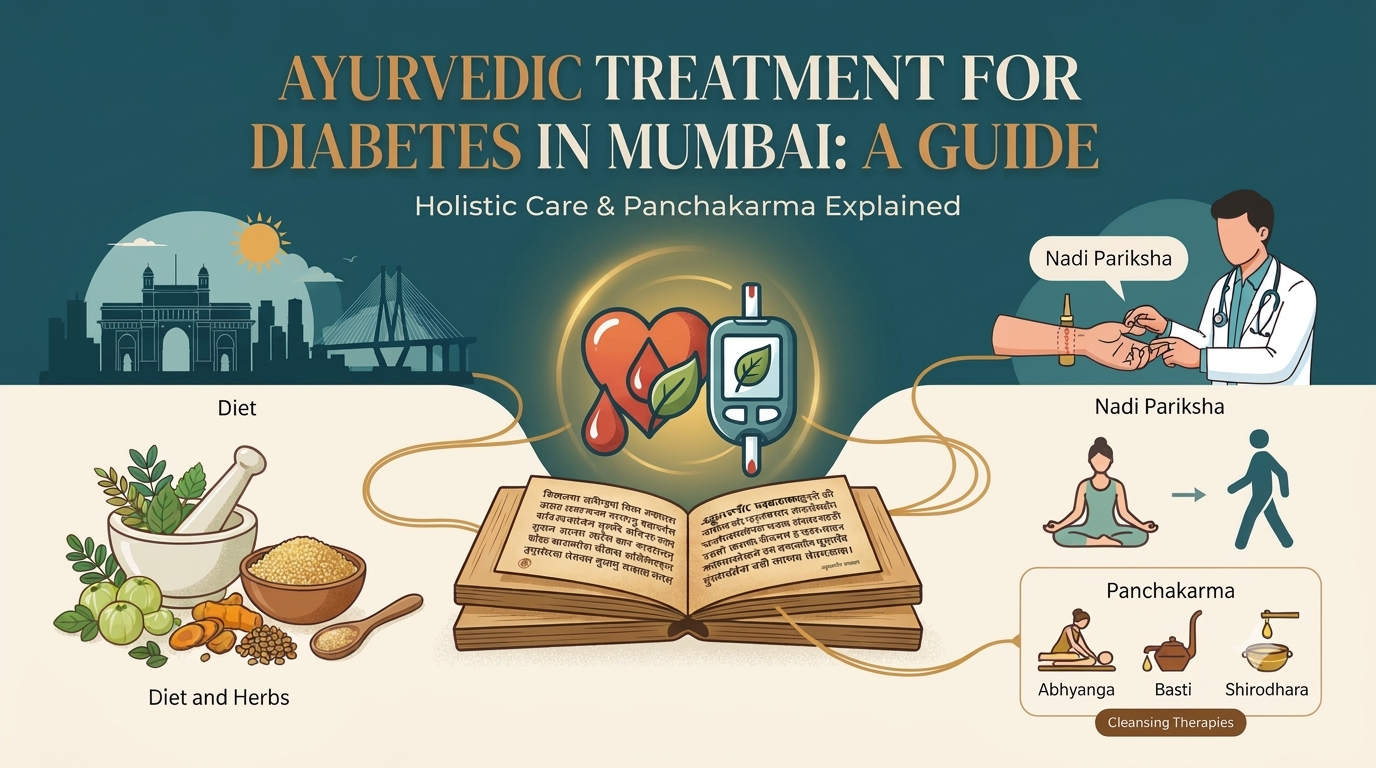
Ayurveda has looked at this condition for thousands of years. It has its own name for it, its own view of the causes, and its own way of caring for the whole person. In this guide I will explain that view in plain words. I will also take you through Panchakarma, the set of cleansing therapies, one therapy at a time.
How does Ayurveda understand diabetes?
In Ayurveda, diabetes belongs to a group of conditions called Prameha. The name points to passing too much urine, often cloudy or sticky. Ancient books such as the Charaka Samhita and the Sushruta Samhita describe Prameha in great detail.
To follow that description, you need three words first. They are Vata, Pitta and Kapha, and together they are called the doshas. Think of them as the body’s weather. Vata is dry and windy. Pitta is hot and sharp. Kapha is cool, heavy and slow. Every person has a mix of all three, and the mix is different for each of us.
The old books describe 20 kinds of Prameha. Ten are linked to Kapha, six to Pitta and four to Vata. The Kapha kinds are described as the easiest to care for. The Vata kinds are described as the hardest.
One Vata kind is called Madhumeha, which means “honey urine”, because the urine turns sweet. Ayurvedic doctors use this name for diabetes that has settled deep in the body and become long-standing. The books say Prameha is easier to care for in its early stage. If it is ignored for years, it can turn into Madhumeha.
Four more words will help you as you read:
- Agni is your digestive fire. Picture a stove under a cooking pot. A strong flame cooks the food well. A weak flame leaves it half cooked.
- Ama is the half-cooked, sticky residue left behind when Agni is weak. Think of the oily film that sticks to a pan.
- Meda is fat tissue. In Prameha, the books describe too much Meda and too much Kapha.
- Ojas is the body’s fine essence of strength and resistance. In Madhumeha, the books say Ojas drains away, which is why people feel tired and weak.
What causes Prameha, according to Ayurveda?
The books point to everyday habits more than to any single cause. These are the ones they name most often:
- Sitting for long hours and too little movement
- Sleeping in the daytime, or sleeping too much
- A lot of sweet, oily and heavy food
- Eating again before the last meal has been digested
- Stress and worry that go on for a long time
The books also describe Prameha that runs in families. This does not mean it is fixed. It means a person with such a family history needs to take extra care with food and routine.
Put simply, the Ayurvedic picture is this: weak Agni, too much Kapha and Meda, and Vata that is thrown out of balance. Treatment aims to correct that whole picture, and not only to deal with one symptom.
Why is treatment different for each person?
The classical books describe two broad kinds of person with Prameha. One is well-built, heavy and strong. The other is thin, weak and easily tired.
For the first, the books advise lightening and cleansing treatments. For the second, they advise nourishing treatments and building strength first. Strong cleansing is not suitable for a person who is already weak.
Think of a garden. A strong, heavy tree can take a vigorous pruning. A thin sapling needs water and care first. This is why two people with the same diagnosis may get very different plans from me.
A strong, heavy tree can take a vigorous pruning. A thin sapling needs water and care first.
How I assess a person
Nadi Pariksha means pulse reading. It is a traditional way of feeling the pulse at the wrist to understand a person’s balance of doshas. Think of a skilled musician who can tell from the pitch and rhythm whether an instrument is in tune. In more than 20 years, I have felt thousands of pulses, and it remains an important part of my assessment.
But I do not rely on the pulse alone. I listen to your story. I ask about your food, sleep, digestion, energy and stress. I look at your body type and your strength. And I ask to see any reports you already have. If you would like to read more, I have explained Nadi Pariksha : A simple guide to pulse diagnosis in a separate article.
What does Ayurvedic treatment for diabetes involve?
Classical care rests on a few pillars. A plan is built from them, in the order and amount that suits you.
Removing the cause
The books call this Nidana Parivarjana. It simply means stopping what feeds the problem. That may mean less daytime sleep, fewer late heavy dinners, less constant snacking, or fewer long hours of sitting. It is often the most useful step, and the one people talk about least.
Food
Food is the heart of Ayurvedic care. Every plan is personal, but the general leaning is towards:
- Regular meal times, with a lighter dinner taken early
- Freshly cooked, warm food
- Barley, millets and moong dal in place of heavy, sticky grains
- Plenty of vegetables, especially bitter and astringent ones, such as bitter gourd and fenugreek leaves
- Less sugar, sweets, fried food and cold drinks
If you take diabetes medicines, a big change in food can push your sugar too low. So please tell your doctor before you change your diet in a big way.
Movement and daily routine
The books recommend daily exercise. They also give a gentle rule: exercise only up to about half of your strength. You should breathe a little faster, but still be able to speak a sentence. A walk after meals is a good start. Many people also like simple yoga and slow breathing practices, such as alternate nostril breathing, learned from a trained teacher. If you have a heart, joint or nerve problem, please check with your doctor first.
Herbs and medicines
Ayurveda has many herbs that have been used in Prameha for a long time. Some of the best known are turmeric, amla, guduchi, fenugreek, neem, gudmar and vijaysar. A doctor may give them as a decoction, a powder or a tablet.
Please do not start herbs on your own. Some can lower your sugar further when taken with diabetes medicines. The right herb, form and amount depend on the person.
Panchakarma
The last pillar is Panchakarma, the cleansing therapies. It needs a section of its own, and here it is.
Panchakarma for diabetes: what are the therapies?
Panchakarma means “five actions”. It is a set of cleansing therapies, done under supervision. The idea is to clear what has built up in the body, especially excess Kapha and Ama, and to bring the doshas back into balance.
Let me be clear about what Panchakarma is not. It is not a quick fix. It is not one therapy that “treats diabetes”. A doctor chooses from this list based on your body type, strength, doshas, age and the season. Some people are not suited to it at all.
Here is the full list at a glance. After it, I explain each therapy in plain words.
| Therapy | What it is | Traditionally used for |
| Snehana and Swedana (preparation) | Oil therapy, then gentle herbal sweating | Getting the body ready for cleansing |
| Vamana | Supervised, medicine-induced vomiting | Excess Kapha in strong, heavy people |
| Virechana | Supervised, medicine-induced loose motions | Excess Pitta and Kapha |
| Basti | Medicated enema, oil-based or decoction-based | Vata imbalance, including nerve symptoms |
| Nasya | Medicated drops in the nose | Head and neck area; a supporting therapy |
| Raktamokshana | Removal of a small amount of blood | Selected skin conditions; rarely used in diabetes |
| Udvartana (supportive) | Dry herbal powder massage | Reducing Kapha and Meda |
Step one: preparation (Purvakarma)
Before the main therapy, the body is prepared for several days. There are two parts.
- Snehana means oiling. You may take small, slowly rising amounts of medicated ghee or oil by mouth, and have a warm oil massage called Abhyanga. This softens and loosens what has built up.
- Swedana means sweating. You sit or lie in a gentle herbal steam, or have warm herbal poultices applied. This helps loosen it further.
In diabetes, doctors are careful at this stage. The heat is kept mild, and the oils are chosen with care.
Vamana: therapeutic vomiting
In Vamana, a herbal preparation is given to bring up the excess Kapha from the chest and stomach. It is done in the morning, under close watch, after the preparation days. The books describe it for strong, heavy people with Kapha-type Prameha.
What does it feel like? You may feel nausea first, then vomit several times over an hour or two. Many people feel tired at first and lighter later. You rest afterwards and eat very light food.
Vamana is not for people who are weak, elderly or pregnant, or who have heart or lung trouble. The books suggest spring as the best season for it.
Virechana: therapeutic purgation
In Virechana, a herbal medicine is given to cause loose motions and clear excess Pitta and Kapha from the gut and liver region. It is one of the therapies most often named for Prameha.
On the day, you take the medicine in the morning and have several loose motions through the day. You sip warm water as advised and eat a light, simple diet. Many people feel tired for a day. You rest, and your doctor watches your strength.
Because the body loses water and strength, Virechana is not suitable for people who are frail, very thin or pregnant. The books suggest early autumn as the best season for it.
Basti: medicated enema
The books call Basti the most important therapy for Vata. Vata is the dosha behind Madhumeha, and behind nerve symptoms such as numbness and burning. A prepared liquid is placed gently into the lower gut through a small, soft tube, held for a short time, and then passed.
There are two main kinds:
- Anuvasana Basti uses oil. It stays in the body longer and nourishes.
- Niruha or Asthapana Basti uses a herbal decoction. It cleanses.
Classical texts describe bitter herbs such as neem in enemas for Prameha. Basti is usually given as a course over several days, not just once. You lie on your left side, it takes a few minutes, and most people find it gentle. The books suggest the rainy season for Basti.
Nasya: medicated nasal drops
In Nasya, after a gentle face and neck massage and a little steam, a few drops of medicated oil or powder are put into the nostrils. It is meant to clear the head and neck area. In diabetes care, it is a supporting therapy and not a main one. It may be added when heaviness or congestion in the head and neck is part of the picture.
Raktamokshana: letting a small amount of blood
This is the fifth therapy in some classical lists. A small amount of blood is removed in a controlled way, for example with leeches. It was traditionally used for certain skin conditions linked with heat.
In diabetes, it is used rarely. Skin and wounds may heal slowly, so it needs great care and a skilled hand. Many doctors do not use it for diabetes at all. If anyone suggests it to you, ask why, and ask how it will be done safely.
Supportive therapies often used alongside
These are not part of the five, but you will see them often in Prameha care.
- Udvartana is a dry massage with herbal powder, done firmly in the upward direction. The books use it to reduce Kapha and Meda. It suits heavier body types.
- Abhyanga is a warm oil massage. It calms Vata and is often used when there is stiffness, dryness or numbness.
- Pottali or Patra Pinda Sweda uses warm bundles of herbs or leaves to give a gentle sweat. The heat is carefully controlled.
- Shirodhara and Takradhara mean a gentle stream of warm oil (Shirodhara) or medicated buttermilk (Takradhara) over the forehead. They are used to calm the mind and support sleep.
To read more about Panchakarma, read my article – What is Panchakarma treatment in Ayurveda?
After the therapies
When the cleansing is over, the body is delicate. Your food is brought back step by step. First comes thin rice water or soft gruel, then soft meals, then your normal diet, over a few days. The books call this Samsarjana Krama. After that comes a period of settling and rebuilding with herbs, diet and routine. This stage is just as important as the cleansing itself.
Who should be careful with Panchakarma?
A cleansing course takes strength out of the body. So I first check your strength, your digestion and your age. Panchakarma is usually not advised if you are:
A cleansing course takes strength out of the body. So I first check your strength, your digestion and your age.
- Very weak, very thin or frail
- Elderly with poor strength
- Pregnant
- A child
- Living with serious heart, kidney or liver trouble
- Going through a period of very high or very low sugar
In such cases, I begin with nourishing care, food, routine and gentle herbs. Cleansing may come later, or not at all.
During any cleansing course, your meals are light and different from usual, and the body may lose water. If you take diabetes medicines, your own doctor should know about the course before it starts. Please do not adjust your doses yourself.
Does the season matter?
The books match each therapy to a season: Vamana in spring, Virechana in early autumn, and Basti in the rainy season. Mumbai has a long, humid monsoon and mild winters, so I plan the timing with each person and do not follow the calendar blindly.
Who may benefit from Ayurvedic care for diabetes?
Early signs and prediabetes
Ayurveda describes warning signs before Prameha fully settles. They include tiredness, a feeling of heaviness, burning in the palms and soles, sticky sweat, a sweet or sticky feeling in the mouth, and passing urine more often. Please do not use this list to diagnose yourself. Only a proper check by a doctor can tell you where you stand.
If your sugar is a little higher than normal, which many people call prediabetes, this is the stage where the books say care works best. Food, movement, routine and gentle herbs are the main tools. Cleansing is sometimes added.
Type 2 diabetes (Madhumeha)
For people living with type 2 diabetes, Ayurvedic care is built around body type, strength and doshas, as I described above. It sits alongside the medicines you already take. What I hope to offer is better digestion, steadier energy, better sleep, a calmer mind and a routine you can keep. I do not offer to replace your medicines.
Insulin resistance and PCOS
Some people come to me with insulin resistance, often with weight gain or irregular periods (PCOS). Ayurveda sees heaviness, too much Meda and weak Agni in such a picture. Care focuses on digestion, regular movement, food and herbs chosen for the person. Udvartana and some cleansing therapies may be used for heavier body types.
Diabetic neuropathy
Some people with diabetes feel burning, tingling or numbness in the feet. Ayurveda describes these as Vata that is disturbed, often with Pitta heat. Therapies such as Abhyanga, gentle Pottali Sweda, Udvartana and Basti are used to support comfort and nourish the nerves. They may help some people feel better. I cannot promise that damaged nerves will be repaired.
There is one more thing I want you to know. If your feet are numb, you may not feel heat. Warm oil, steam and herbal bundles can burn the skin without you noticing. So heat on the feet must be mild, and the skin must be checked often.
If your feet are numb, you may not feel heat.
Please see a doctor promptly if you notice a sore on your foot, a wound that is slow to heal, or a sudden change in feeling.
What can I expect at my first visit?
A first visit should feel calm and unhurried. This is how it usually goes:
- We talk about your health story, your food, sleep, digestion, energy and stress.
- I look at your body type and read your pulse.
- I explain the readings found in pulse. I also examine your tongue, skin, eyes
- I ask to see any reports and medicine strips you already have.
- We agree a plan together, usually starting with food and routine.
I will not ask you to stop any medicine you are taking. You are welcome to bring a family member, and many people do.
The plan is personal, and it is reviewed over time. If cleansing is right for you, I explain each step before it starts, including how you may feel.
How long does Ayurvedic treatment for diabetes take?
There is no fixed timeline. Prameha builds up over years, so care is a steady process and not a short course.
A cleansing course, if you need one, usually runs for a number of days. After it comes a longer period of food, routine and herbs, over months. Some people tell me they notice better digestion, energy and sleep within a few weeks. This is different for everyone.
By progress I mean things like better energy, less thirst, fewer trips to pass urine, better sleep, and steadier readings on the checks your doctor advises. I cannot promise any particular result.
Frequently asked questions
How many days does Panchakarma take for diabetes?
It depends on the energy reading and imbalances of Dosha found in Nadi Pariksha. A course usually runs for some days, with preparation first, then the main therapy, then a slow return to normal food. Your doctor should explain the plan before it starts.
Which Panchakarma therapy is best for diabetes?
There is no single best one. Vamana and Virechana are mostly used for strong, heavier people. Basti is usually chosen when Vata is involved, including numbness and burning. The right choice depends on your body type, strength and doshas.
Is Panchakarma safe for everyone with diabetes?
No. It is not advised for people who are weak, frail, pregnant or very unwell, or whose sugar is swinging high or low. A doctor must assess you first.
Will I have to change my food completely?
Not overnight. I make changes step by step, starting with meal timings and the heavy, sticky or very sweet foods, so that you can keep them up.
A last word before you go
Living with diabetes is a long road. In my years of practice, I have noticed that small, steady habits matter more than big promises. Food, movement, sleep and a calm mind may not sound exciting, but the old books place them first for good reason. Asking questions before you start any treatment is the right instinct, so please keep asking them.
If you would like to talk through your own situation, I am happy to sit down with you at Vedang Clinic in Bandra. There is no pressure, and you are welcome to bring a family member.
A meritorious alumna of the prestigious RA Poddar Ayurvedic College with profound spiritual understanding. She is trained in Nadi vidya by a strict guru-shishya lineage and has clinical experience with more than 20 years. An excellent orator who has been invited to various national and international platforms that empower audiences with the knowledge of Āyurveda. Dr. Rushalli Nair is the first-ever lady Vaidya who has been invited to Swaminarayan temple to offer her services to Sadhvis and devotees.