
Every week, visitors come to Vedang Clinic asking, “Is Panchakarma a perfect detox? Can I begin?”
This question entirely makes sense. The name “Panchakarma” has almost become a trendy word in wellness circles — everybody talks about it, shares it on their social media pages, and the mere mention of it makes one believe that any Panchakarma clinic with a heating device and a massage table can do the job. The only problem is that what people don’t know is that **Panchakarma without Nadi Pariksha is not Ayurveda, it is just some guessing game with an Ayurvedic name.**
Panchakarma can heal. However, its healing effect must be based on a proper diagnosis. It must not rely on a mere questionnaire or a pulse check at the front desk, but on a proper Nadi Pariksha — a slow and detailed reading of the pulse of the body
Understanding what Panchakarma is All About
Panchakarma literally means “five actions.” The procedure consists five purification processes known as **Vamana** (therapeutic vomiting), **Virechana** (therapeutic purgation), **Sneh Basti** (oil-based enema), **Niruha Basti** (decoction enema), and **Nasyam**(nasal administration of herbal oils), which enables removal of toxins (toxins) from the body of the person receiving treatment. It is also known as *Shodhana Chikitsa* meaning cleansing therapy and has been considered the most scientifically validated detoxification procedure among different tradition medicines.
But here’s the part that gets lost in modern marketing: not every therapy is right for every person, and definitely not in the same dose, duration, or oil. Panchakarma is not one treatment. It’s a group of very different, very powerful interventions — and choosing the wrong one, or the right one delivered incorrectly, can do more harm than good.
This is exactly where Nadi Pariksha becomes non-negotiable.
What Nadi Pariksha Reveals
Nadi Pariksha is more than just a simple wrist check. During a proper reading, we assess pulse strength from all the positions and depths in use to reveal a wide range of conditions that most people wouldn’t necessarily think are discoverable.
- Your Prakruti (constitution) and Vikruti (current imbalance). Each person has a specific dosha ratio at birth, and throughout life, that ratio has been altered due to stress, diet, and lifestyle conditions. Nadi Pariksha identifies both the original ratio and its deviation.
- Nadi Pariksha enables us to evaluate the state of the health of organs with their functional efficiency in the form of their energy and if they can toleratehttps://www.wisdomlib.org/definition/prakirti purification.
- The impact of psychological and emotional states.** The concept that is the most surprising for the majority of people. According to Ayurveda, many common ailments have roots in *psychosomatic* issues, meaning that there is an unresolved emotional issue – bereavement, suppressed anger or anxiety, and trauma that manifests in the body through its tissue. Nadi Pariksha process picks this up right away. For instance, a patient who thinks that she/he just wants detoxification may be sharing a lot of emotional baggage that plays a significant role in the wellness process.
- Significant health symptoms – It is possible to speak of the specific pulse patterns indicating medical problems that would not allow to undertake certain procedures.
This is why, at Vedang, I ask patients not to explain their symptoms before the pulse reading. The diagnosis needs to happen without being coloured by what the patient ‘thinks’ is wrong — because so often, what the pulse reveals is a different, deeper story than the one the patient came in to tell.
How This Changes Which Therapy You Need
Here’s where it becomes concrete. Let’s walk through a few examples of how a Nadi Pariksha reading directly shapes the therapy that follows.
Example 1: Vamana (Therapeutic Emesis)
Vamana is most effective in conditions where there is a predominance of Kapha, such as chronic congestion, skin diseases and sluggish metabolism due to excess of Kapha. However, Vamana can be rather taxing on the body. When Nadi Pariksha indicates weak Agni, physical power and heart problems — all of which can be assessed through a pulse — it simply shows that Vamana treatment is not suitable in this case irrespective of the classical symptoms evidencing the need for Vamana. Without such verification, a well-meaning Ayurvedic Panchakarma center may suggest Vamana to a patient whose body is able to cope with a procedure.
Example 2: Virechana (Purgation)
Virechana is recommended for treating conditions resulting from Pitta disturbances such as skin diseases, heartburn, and certain liver and gallbladder problems. However, the herbs used in this procedure depend on the severity of the Pitta imbalance and the possible role of Vata or Kapha. In other words, it’s one thing to treat a patient suffering from pure Pitta imbalance and quite another matter to treat a patient suffering from Pitta imbalance combined with anxiety driven by Vata. The Nadi Pariksha helps the practitioner to determine the right treatment.
Example 3: The application of Basti treatments which includes Sneh Basti and Niruha Basti
The treatment of Basti is known to be the ultimate therapy used in Ayurveda to treat disorders of Vata such as the disease of the joints, neurological diseases, chronic constipation, and also certain psychological problems. Multifaceted, Basti is also adaptable in every instance. The type of oil used, decoction, the proportions we use between the two, and number of sessions is decided only after determining the severity of the Vata trouble and the strength possessed by the body tissues of the patient. Nadi Pariksha will help us with the prescription which will determine the oil and the number of sessions before we conduct a further check-up.
Example 4: Application of Nasyam
Nasyam is frequently employed to treat sinus problems, migraines and mental lethargy. This is because Ayurveda regards the nasal passage a straight link to the brain. However, the kind of oil to be used in Nasyam for reducing Vata (as for instance, in headaches due to anxiety) will be entirely different from the oil prescribed for clearing out Kapha.
Example 5 : Shiropichu and Shirodhara
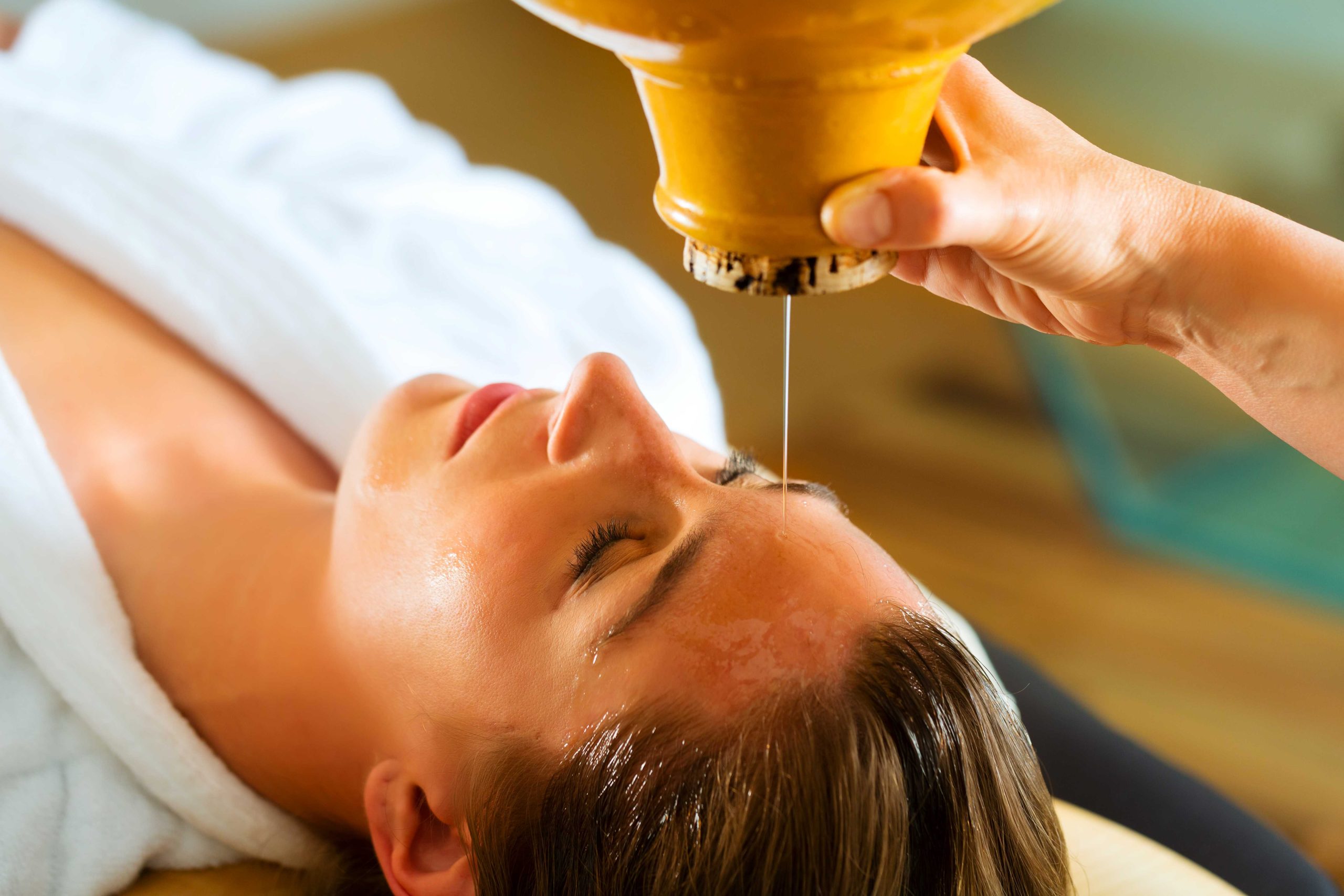
Shiropichu and Shirodhara are two of the most sought-after therapies at Vedang Clinic. And rightly so! Both therapies have a significant impact on the head and the nervous system and have become the preferred solutions for a modern-day set of issues: disturbed sleep, excessive thoughts running wild, the inability to stop thinking, and problems in concentrating on one task.
Shiropichu involves soaking a cotton pad in warm medicated oil and placing it on the crown of the head (the *Brahma randhra*) so that the oil slowly penetrates and relaxes the nervous system. On the other hand, Shirodhara is characterized by a steady flow of warm oil or medicated buttermilk poured over the forehead in a continuous manner to relieve patient from the mental chatter and bring them a deeper relaxation.
Both treatments are fundamentally Vata-reducing therapies, as lack of sleep, excessive worrying, and difficulties concentrating are mostly manifestations of excess Prana Vata – the type of Vata responsible for mind, senses, and nervous system.
This is where Nadi Pariksha becomes essential. A patient describing “trouble sleeping” could be dealing with pure Vata aggravation from stress, Pitta-driven mental agitation (often laced with irritability or a racing, critical inner voice), or Kapha-linked heaviness presenting as low motivation and fog rather than true anxiety. These look similar on the surface. On the pulse, they are unmistakably different.
Through Nadi Pariksha, we can identify:
– Whether the root cause is truly Vata, or whether another dosha is driving the presentation — which determines whether Shiropichu or Shirodhara is even the right therapy to begin with
– How deeply the imbalance has settled — a mild, recent disruption in sleep responds very differently than a Vata imbalance that has been building for years, often since a specific life event or period of chronic stress
– The emotional layer underneath the physical symptom — Nadi Pariksha frequently reveals that “overthinking” is, underneath, a nervous system holding onto unprocessed anxiety, grief, or fear that the patient hasn’t consciously connected to their sleep or focus difficulties
– Which oil or liquid should be used — Shirodhara, for instance, may use a Vata-pacifying oil like Ksheerabala for pure nervous exhaustion, a cooling medicated buttermilk (Takradhara) for Pitta-driven agitation, or a different formulation entirely for Kapha-linked mental heaviness. Using the wrong base liquid can leave the patient feeling no different — or occasionally more unsettled
– Duration and frequency — a course of 7 days delivers a very different outcome than a single session, and Nadi Pariksha helps determine how many consecutive days are actually needed for the nervous system to shift into a lasting state of calm, versus a temporary sense of relaxation that fades within hours
I’ve seen this play out often: a patient arrives certain they simply need “a Shirodhara for stress,” and the pulse reveals something more specific — perhaps a Pitta imbalance sitting underneath what looks like Vata-driven anxiety, requiring a cooling Takradhara rather than a warming oil-based Shirodhara. Without the diagnosis, the well-intentioned but generic choice may bring temporary comfort without ever touching the root cause of the sleeplessness or the overthinking.
The Dangers of Skipping a Key Step
Panchakarma administered without a proper Nadi Pariksha isn’t just less effective — it can genuinely backfire. For example, a Vamana can leave its patient drained for weeks if its strength is below average, or a Basti containing the wrong oil can do just the opposite of soothing the body – making it even more restless instead. Also, one detox cure can’t be right for everyone, which disregards one of Ayurveda’s fundamental principles, which states that every person is different.
This also explains the importance of duration when conducting the treatment. For example, how many days will the Basti be applied? How many cycles of Virechana? What is the duration of the oleation phase before the main treatment? Contrary to that, these dilemmas are not solved by any patterns used throughout brochures but rather take into account the unique characteristics of the person who undergoes the treatment.
The Real Risk of Skipping This Step
Panchakarma administered without a proper Nadi Pariksha isn’t just less effective — it can genuinely backfire. A Vamana given to someone with low strength can leave them depleted for weeks. A Basti with the wrong oil can aggravate rather than calm. A detox package sold as “one size fits all” ignores the very principle Ayurveda was built on: that no two bodies, minds, or imbalances are the same.
This is also why duration matters so much. How many days of Basti? How many rounds of Virechana? How long should the oleation phase run before the main procedure begins? These aren’t standard numbers pulled from a brochure — they are decisions made specifically for *your* Prakruti, *your* Vikruti, and *your* body’s current capacity to detoxify safely.
The Bottom Line
Think of Nadi Pariksha as the map, and Panchakarma as the journey. You would never set out on a significant journey without first knowing exactly where you’re starting from — and yet that’s precisely what happens when Panchakarma is administered without proper pulse diagnosis first.
If you’re considering Panchakarma, don’t begin with a package.
Begin with understanding your body.
At Vedang Clinic, every Panchakarma program starts with a detailed Nadi Pariksha so the therapies, herbs, oils, and treatment schedule are tailored to your constitution, your current imbalance, and your body’s readiness for purification.
Because in Ayurveda, successful treatment doesn’t begin with therapy.
It begins with diagnosis

A meritorious alumna of the prestigious RA Poddar Ayurvedic College with profound spiritual understanding. She is trained in Nadi vidya by a strict guru-shishya lineage and has clinical experience with more than 20 years. An excellent orator who has been invited to various national and international platforms that empower audiences with the knowledge of Āyurveda. Dr. Rushalli Nair is the first-ever lady Vaidya who has been invited to Swaminarayan temple to offer her services to Sadhvis and devotees.