
If someone has told you to try Nadi Pariksha and you are not sure what it means, you are not alone. It is one of the questions I hear most often in my practice.
I am Dr. Rushalli Nair. I have practised Ayurvedic medicine for over 20 years, and reading the pulse is part of my work every day. In this guide I will explain Nadi Pariksha in plain words. You do not need any medical background to follow it.
I will also be honest about what it cannot do. That part matters just as much.
What is Nadi Pariksha?
Nadi Pariksha is a way of understanding a person’s health by feeling the pulse at the wrist. It comes from Ayurveda, a traditional system of medicine from India that has been practised for many centuries. In English, people often call it Ayurvedic pulse diagnosis.
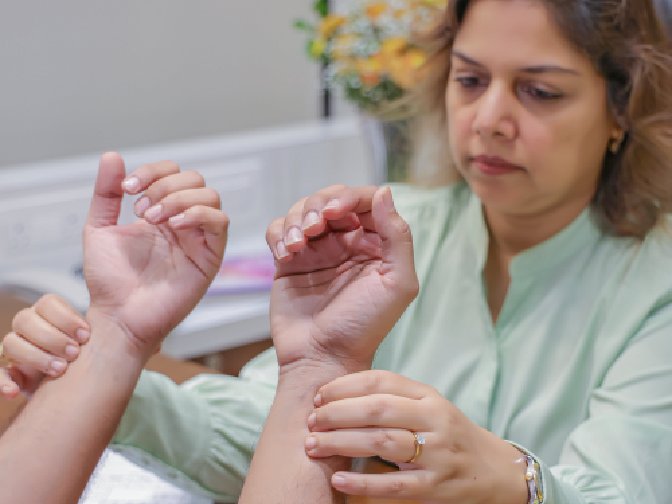
When I do it, I rest three fingers on your pulse and notice its pattern. I then use that pattern, together with what you tell me, to understand your overall health. It takes time to learn, and it cannot be rushed.
What does “Nadi Pariksha” mean?
The words come from Sanskrit, an old language of India. Nadi means pulse. It can also mean a channel or vessel. Pariksha means examination, or a careful check. So Nadi Pariksha simply means “examining the pulse”.
A doctor trained to do this is called a Nadi Vaidya. Vaidya is the traditional word for an Ayurvedic doctor. If you would like to say it aloud, it sounds like NAH-dee pah-REEK-shah.
Is this the same as my doctor checking my pulse?
Not quite. When your regular doctor checks your pulse, they usually count the beats in a minute and notice whether the rhythm is steady. That is very useful, and it tells them things about your heart.
In Nadi Pariksha I notice more than the count. I pay attention to how strong the pulse feels, how quick or slow it is, how regular the rhythm is, and its overall quality under my fingers. I then think about these in Ayurvedic terms.
These are two different ways of looking at the body. Neither one replaces the other.
Where does Nadi Pariksha come from?
Ayurvedic texts describe several ways of examining a patient. Feeling the pulse is one of them. The others include looking at the tongue, the eyes and the skin, listening to the voice, and asking about urine and stools. Traditionally this is known as the eightfold examination.
Later Ayurvedic texts, including the Sharangadhara Samhita and the Yogaratnakara, are often cited as describing pulse examination in more detail. Vaidyas have passed the skill down to their students over many generations.
I mention this so you know the practice has a long history. But an old practice is not automatically a perfect one, which is why I will also talk about its limits below.
How does Nadi Pariksha work?
Nadi Pariksha is built on an Ayurvedic idea called the doshas. Let me explain that first.
You can read our blog ‘understanding the dosha and Ayurvedic body type – know yourself through Ayurveda’ to know more about doshas.
What is a “dosha”?
A dosha is one of three basic energy patterns Ayurveda uses to describe how a person’s body and mind tend to work. The three are called Vata, Pitta and Kapha.
Here is a simple way to picture them:
- Vata is the energy of movement, like the wind.
- Pitta is heat and change, mainly the energy of transformation.
- Kapha is steadiness, like the building blocks of the body.
Ayurveda says all three are present in everyone. Most people are a mix, with one or two a little stronger. This is a traditional way of describing tendencies. It is not something measured in a laboratory, and the pictures above are only there to help you remember.
What does the Nadi Vaidya actually feel for?
I place three fingers lightly along the artery at your wrist (the blood vessel where you feel your pulse). These are the index, middle and ring fingers. In the traditional method, the index finger is linked with Vata, the middle finger with Pitta and the ring finger with Kapha. Traditions differ on some finer details, such as which wrist to use.
As I feel the pulse, I notice its speed, its strength, its rhythm and its overall feel. In my years of practice, I have found that this cannot be hurried. I get the clearest sense when the room is quiet and the person in front of me is calm.
What does the reading tell me?
The pulse alone is not the whole story. I use it together with what you tell me about your sleep, digestion, energy, stress and health history. It gives me a starting point, and it may point to patterns worth looking at more closely.
I do not use it to name a disease. It helps me understand patterns in your health. If I feel something needs a proper medical test, I will say so.
What does a Nadi Pariksha visit feel like?
If you are nervous, please know that a visit is quiet and gentle. The pulse reading itself uses only my fingers, and it should not hurt.
Here is how a visit usually goes:
- We take details . I ask about your name, address and age.
- I feel your pulse. You sit comfortably while I rest my fingers on your wrist. This part is silent.
- I explain what I noticed, in plain words. You can ask me anything.
- We talk about simple next steps, which may include food and lifestyle suggestions.
A few tips. Come when you are calm and not in a rush. Bring any recent medical reports and a list of the medicines you take. Your Vaidya may also give you simple pre consultation guidelines, such as when to eat beforehand, so it is worth asking.
You are welcome to bring a family member. Many older patients feel more at ease that way. And it takes time, because I would rather explain well than finish quickly.
What can Nadi Pariksha help with, and what can it not do?
Some patients come to me with everyday concerns such as stress, poor sleep, digestion troubles or feeling tired much of the time. For some of them, Nadi Pariksha is a helpful way to look at their habits and lifestyle. Some patients also tell me they value being listened to and having things explained slowly. In my experience, these are the benefits people notice most often, and I cannot promise them for everyone.
Here is what it cannot do. It cannot replace blood tests, scans or emergency care. It cannot confirm or rule out a specific disease. Only proper medical tests can do that.
I also want to be honest about the evidence. Nadi Pariksha has a long tradition, and I trust my own years of experience with it. But careful scientific studies of it are limited, and there is still debate about how consistently different practitioners read the same pulse.
Who should be careful, and when should I see a doctor first?
If you have serious or sudden symptoms, please see a conventional doctor first.
Please get medical help right away, or go to the nearest hospital, if you have any of these:
- Chest pain or pressure
- Sudden weakness in the face, arm or leg, or trouble speaking
- Severe breathlessness
- Sudden confusion
- Heavy bleeding
- A high fever that will not settle
If you take medicines for a long-term condition, such as blood pressure, diabetes, a heart problem or blood thinners, please keep taking them unless your own doctor tells you otherwise. Tell every doctor you see about everything you are trying, including Ayurvedic advice.
If you are pregnant, or if the patient is a young child, please speak with your regular doctor first, and tell your Vaidya.
How do I find a trained Nadi Vaidya?
Whether you live in Mumbai or elsewhere, a few simple checks can help you choose well. They are worth doing if you are searching for a Nadi Vaidya near you.
- Ask about training. A formal qualification such as BAMS (Bachelor of Ayurvedic Medicine and Surgery) or MD (Ayurveda), and registration with the official Ayurvedic council in their state or country, are good signs.
- Notice how they explain things. A good Vaidya speaks in plain language and welcomes your questions.
- Be careful with big promises. If anyone says they can find every illness from the pulse alone, or guarantees results, please be cautious.
- Trust how you feel. You should feel respected, not rushed or pressured.
These are the standards I try to hold myself to.
Frequently asked questions
Is Nadi Pariksha painful or risky?
No. It is a gentle touch on the wrist. The real risk is not the pulse reading itself. It is putting off medical care that you need. That is why I ask you to read the section above on when to see a doctor first.
Can Nadi Pariksha replace my blood tests?
No. They answer different questions. A blood test measures specific things in your blood. Nadi Pariksha helps me understand your psycho-physiological pattern. Used sensibly, the two can sit side by side.
How long does a session take?
A session takes about 30-45 minutes. I would rather take the time to explain than rush you.
Can it be done online?
A conversation about your history and habits can be done by video. Feeling the pulse itself is traditionally done in person, by touch. A person’ photo of eyes, nails and tongue (with their consent) is studied for online consultation.
Does Nadi Pariksha cost a lot?
Fees differ from one practitioner to another, so I will not quote a number here. It usually depends on things like the length of the visit and what is included.
A last word from me
You do not need to believe in Ayurveda to be curious about it. What I hope you take away is that Nadi Pariksha is a patient, unhurried way of paying attention to your health, and that it is one tool among many for looking after it.
If you would like to understand your own pulse and body pattern better, I am happy to walk you through it in person at my clinic in Bandra.
Dr. Rushalli Nair, MD (Ayurvedic Medicine), Vedang Clinic, Bandra West, Mumbai
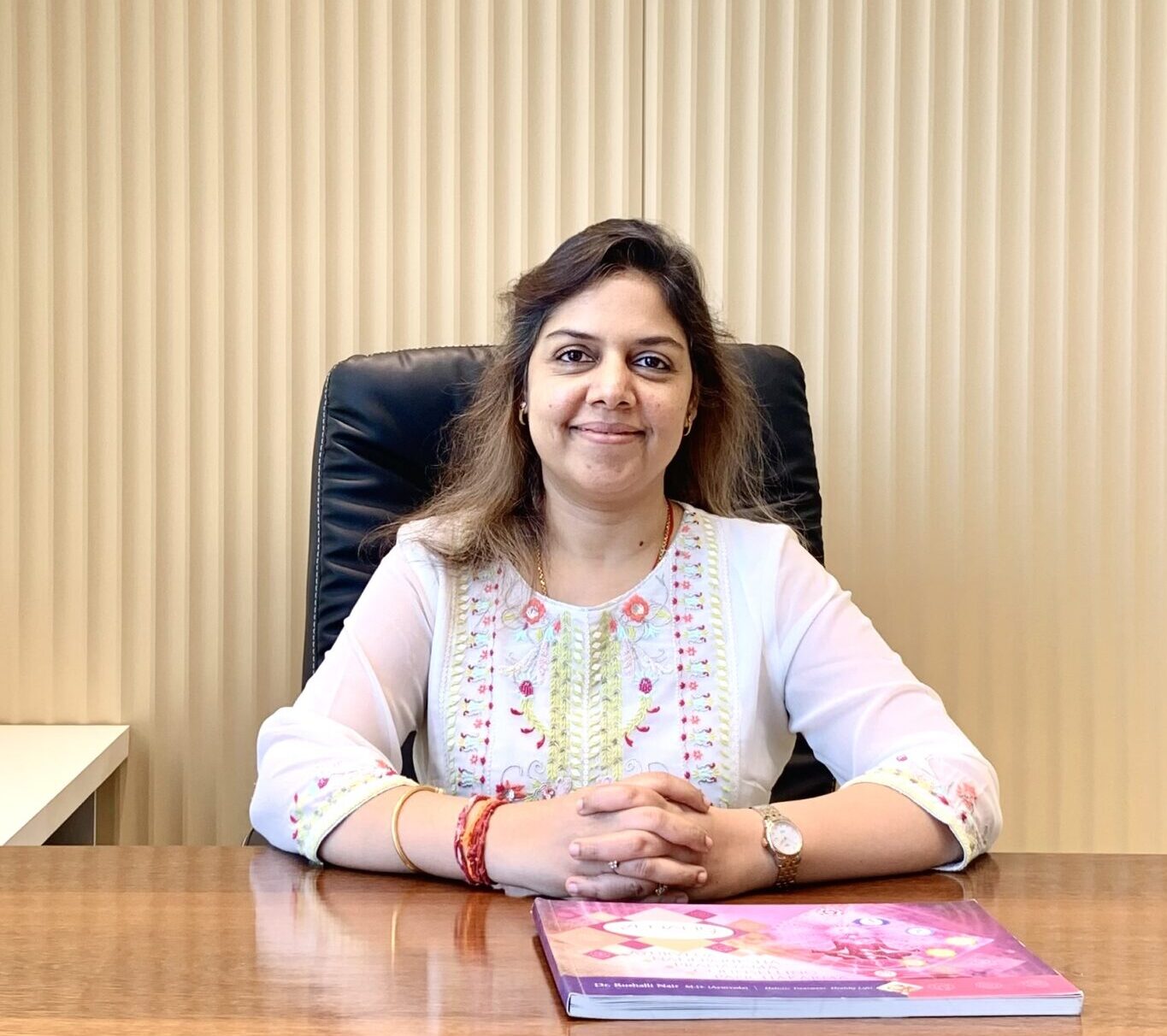
A meritorious alumna of the prestigious RA Poddar Ayurvedic College with profound spiritual understanding. She is trained in Nadi vidya by a strict guru-shishya lineage and has clinical experience with more than 20 years. An excellent orator who has been invited to various national and international platforms that empower audiences with the knowledge of Āyurveda. Dr. Rushalli Nair is the first-ever lady Vaidya who has been invited to Swaminarayan temple to offer her services to Sadhvis and devotees.